Drainage
Blocked Manholes & External Drains
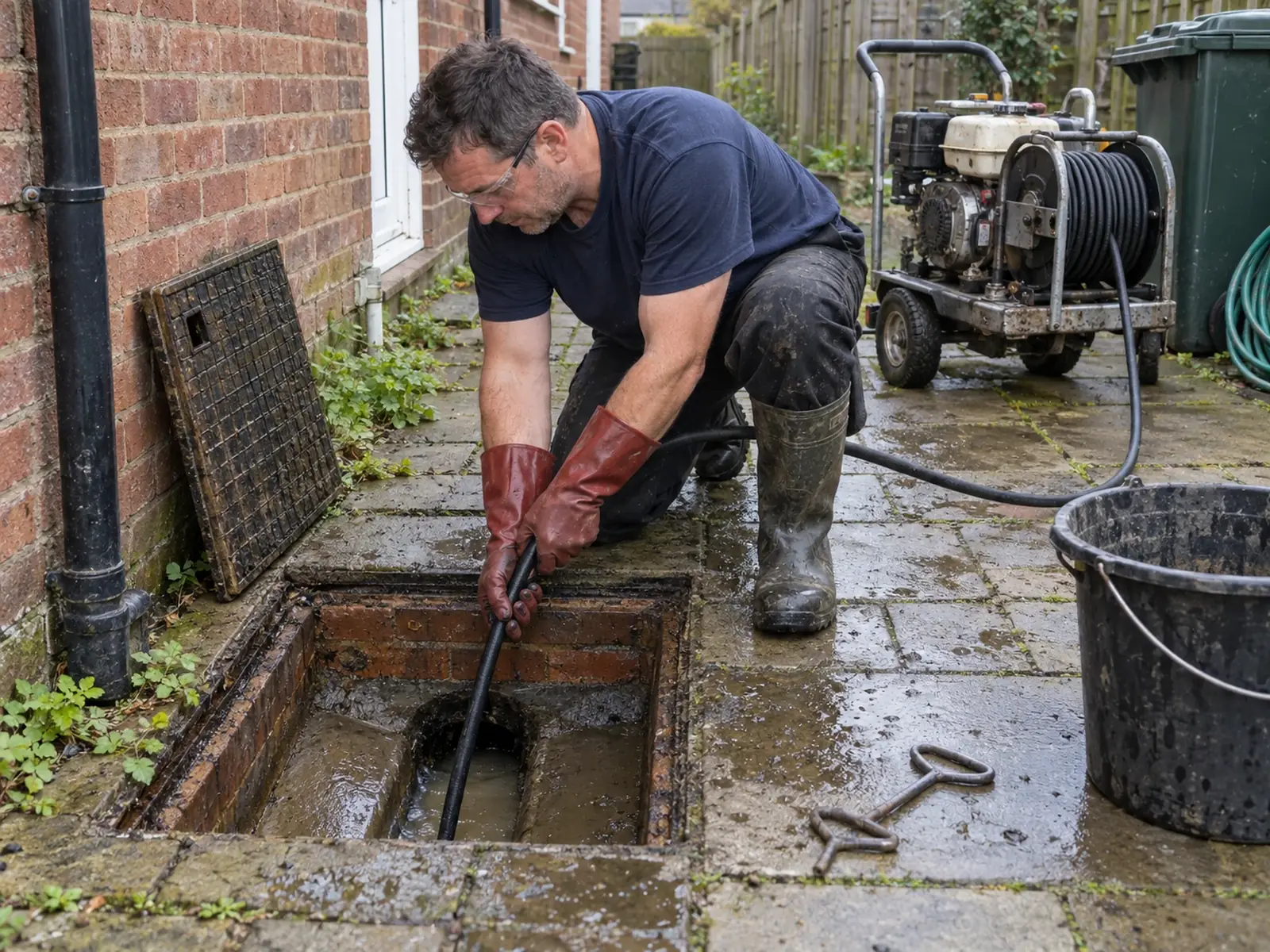
Manholes, inspection chambers, gullies and the underground drains between them.
We confirm the price with you before any work starts.
- No call-out fee
- Qualified professionals
- 12-month workmanship guarantee
- Emergency call-outs
Once waste leaves the building it runs underground through a series of pipes and chambers, and a blockage anywhere along that run backs everything above it up. The house is the first place it shows, but the problem is outside.
An inspection chamber — what most people call a manhole — is an access point built in where pipes join or change direction, so the drain can be inspected and rodded without digging. Those chambers are also the diagnosis: lift the nearest cover and what you find tells you which side of it the blockage is on.
Outside, blockages tend to be roots that have found a cracked joint, silt and leaves washed into a gully, fat set hard along the pipe wall, or a length of drain that has sagged or broken.
The price you see is based on what you tell us. If our engineer finds that more work or materials are needed, they will explain the cost and get your agreement before carrying on — nothing is added without you agreeing to it first.
Do you need this?
You might need this if
- A manhole or inspection chamber standing full of water or sewage
- Several fittings in the house draining slowly at once
- A toilet that bubbles when the bath or washing machine empties
- Waste backing up into the lowest fitting in the property
- Water pooling around an outside gully or drain cover
- A drain smell in the garden, driveway or around a cover
- Wet or sunken ground along the line the drain runs
- A blockage that returns weeks after being cleared
Qualified engineers across London, seven days a week.
On the day
What the work involves
Roughly what to expect. The exact steps vary with the job.
- Step 1:Covers are lifted and the chambers read in order, to fix which length of drain the blockage is in
- Step 2:Drain rods are put in from the nearest access point to shift what can be shifted
- Step 3:High-pressure water jetting cuts apart anything solid and scours the pipe wall as it withdraws
- Step 4:Roots and hardened scale are cut out electro-mechanically, with cutting heads on a rotating cable
- Step 5:The run is flushed through and the chambers watched to confirm it clears properly
- Step 6:A camera survey shows the condition of the pipe where a blockage has returned before
How it works
How booking works
You see what the job costs before giving us any personal details.
-
Step 1: Tell us what you need
Pick your service and answer a few plain-English questions about the job.
-
Step 2: See your price
We show you the price before you give us any personal details.
-
Step 3: Choose your slot
Pick an arrival window that suits you from our genuine availability.
-
Step 4: Pay your deposit
Secure your appointment with a £10 deposit, taken off your final bill.
Questions
Common questions
How do I read the manhole to find the blockage?
Lift the cover nearest the house first and look at what is in the chamber.
A chamber standing full, or with water that is not moving, means the blockage is somewhere after it — further down the run, towards the boundary and the sewer.
A chamber that is empty and dry means everything has drained away past that point, so the blockage is behind you, between the house and that chamber.
If there is more than one cover, keep going towards the boundary. The blockage lies between the last chamber you find full and the first one you find empty.
How do I lift a manhole cover safely?
Use a proper pair of keys or a lifting hook in the two slots — not a screwdriver and not your fingers, because the covers are heavy and the edges are unforgiving. If it has not been lifted in years, run a blade around the rim first to break the seal. Lift with your legs, put it flat beside the opening rather than on its edge, and do not leave an open chamber unattended with children or animals about. If it will not come up, leave it for the engineer.
Is it my drain or the water company's?
The pipes inside your boundary that serve only your property are yours. The sewer beyond your boundary, and any pipe shared with neighbouring properties, belongs to your water company — the private sewer transfer in October 2011 moved those across whatever state they were in.
Thames Water, who cover most of London, put it in terms of symptoms: if the problem is outside your boundary, or more than one property is having trouble at the same time, it is theirs to deal with. If only your home is affected and there is no other flooding nearby, it is very likely on your own drainage. When the signs point outside your boundary, report it to them first — it costs nothing to ask.
Several houses in the street are affected. What then?
That is a strong sign it is the shared sewer rather than anyone's private drain, and that makes it your water company's responsibility. Report it to them. We would rather tell you that than charge you to clear something that was never yours to clear.
What is high-pressure water jetting?
A hose fed down the drain with a jetting head on the end, pumping water at high pressure. The jets break the blockage apart and drive the pieces down the pipe, and because they also work backwards against the pipe wall, the hose scours off the grease film and scale as it is drawn out. That last part is why jetting tends to keep a drain clear longer than simply pushing a blockage through with rods.
Can tree roots really get into a drain?
Easily. Roots follow moisture, and a hairline crack or a slightly open joint is all they need. Once inside they thrive on what is passing and keep growing, and the mass catches everything that goes by. They are cut out with an electro-mechanical cutter — a rotating cable with blades on the end. They will grow back through the same fault, so it is worth finding out where that fault is.
What is a CCTV drain survey and do I need one?
A camera on a flexible rod pushed along the drain, sending video back as it goes. It shows the inside of a pipe nobody can otherwise see — where the blockage was, and whether roots, a crack, a collapse or a sagging section is causing it. You do not need one for a first-time blockage that clears normally. It earns its keep when the same drain blocks repeatedly, or when you want to know the condition of the drains before buying.
What is a gully, and why does it keep filling up?
A gully is the small grated drain at ground level that takes waste from a kitchen waste pipe or rainwater from a downpipe. Being open to the air, it collects leaves, silt, grit and moss washed off the roof, and the trap beneath it fills up. Clearing the grid and the trap out solves most of them.
There is sewage in the chamber right now. What should I do?
Stop using water in the house — taps, toilets, showers, washing machine and dishwasher all included — because anything you send down adds to what already has nowhere to go. Keep people and pets away from it, put the cover back if you have lifted it, and wash your hands properly. Then call us.
How soon can someone come out?
Call us rather than booking online if it will not wait, and tell us what you found in the chamber if you have already looked — it helps the engineer arrive with the right equipment on the van.